Starting a golf simulator business in 2026 costs anywhere from $50,000 for a lean 2-bay studio to over $900,000 for a full-service golf bar. The spread is that wide because four variables do most of the work: how many simulators you deploy, which technology tier you choose, your build-out complexity, and whether you add food and beverage. Get those four right and the rest of the budget falls into place.
That answer covers the ballpark. This guide covers everything else. We surveyed owners, studied real facilities, and built financial models for indoor golf centers at every scale. Below is the most granular cost breakdown available for the 2026 market, including what nobody else tells you about build-out surprises, simulator pricing shifts, and the ongoing monthly burn that trips up first-time owners.
- 01Startup cost ranges at a glance
- 02Simulator costs: what you’re actually buying
- 03Build-out, space, and leasehold improvements
- 04Full cost breakdown by facility size
- 05Monthly operating costs after opening
- 06The hidden costs most projections miss
- 07Revenue and break-even benchmarks
- 08How to fund it
- 09Your next steps
Startup Cost Ranges at a Glance
Before getting into line items, here are the three tiers most new facilities fall into. These include simulators, basic build-out, furniture, technology, and initial working capital. High-end urban leases or premium finishes will push costs toward the top of each range.
| Tier | Startup Cost | Simulators | Space | Hardware and F&B | Team |
|---|---|---|---|---|---|
| Small Studio | $50K – $250K | 2–4 | 1,500–3,200 sq ft | Entry to mid-tier sims, no or minimal F&B | Lean, often owner-operated |
| Mid-Size Center | $350K – $650K | 6–8 | 5,500–10,000 sq ft | Mid-to-premium sims, bar service common | 2–5 staff at launch |
| Full-Service Golf Bar | $750K – $900K+ | 7–10+ | 6,800–12,000+ sq ft | Premium commercial sims, full kitchen and bar | Event hosting capability |
A five-bay venue, or a four-bay studio with a full bar, usually lands between the first two tiers. Price it from the line items in the facility size breakdown below.
These ranges come from our Indoor Golf Business Study and Startup Financial Model, built on surveys of actual facility owners and 2026 equipment pricing. Simulator manufacturer ROI models consistently overstate real-world utilization, so our benchmarks skew conservative on purpose.
This page covers what it costs. Our step-by-step guide covers everything else about opening an indoor golf simulator business: validating your market, choosing a location, picking equipment, insurance, pricing, and your first 90 days of operations.
How to Start a Golf Simulator Business →Simulator Costs: What You’re Actually Buying
The simulator is the product. It’s also where the widest range of decisions happens, because “golf simulator” covers everything from a $5,000 DIY setup to a $100,000 commercial unit with dual-tracking technology.
Technology is the biggest price driver. Radar (Doppler) units like TrackMan and dual-tracking systems sit at the top of the price range, while overhead photometric (camera) units like the Uneekor EYE XO cost far less per bay. Which one fits depends on your ceiling height, room depth, and target customer; our startup guide walks through radar vs. photometric for commercial use. Most successful mid-size centers mix tiers: one or two premium bays for lessons and serious practice, standard bays for leagues and casual play.
Commercial Simulator Pricing by Brand (2026)
| Brand | Technology | Price Range Per Bay | Best For |
|---|---|---|---|
| TrackMan | Doppler radar | $25,000 – $100,000 | Teaching, serious golfers |
| aboutGolf | Dual-track (overhead + floor) | $42,000 – $92,000 | Premium entertainment venues |
| Full Swing | Dual-track | $30,000 – $60,000 | Entertainment + coaching |
| Golfzon | Camera + moving platform | $40,000 – $70,000 | High entertainment factor |
| HD Golf | Camera-based | $35,000 – $70,000 | Upscale commercial |
| TruGolf | Camera-based | $30,000 – $70,000 | Mid-size commercial |
| Uneekor EYE XO | Overhead photometric | $10,000 – $20,000 | Cost-effective commercial |
| ProTee United | Camera-based | $5,200 – $26,200 | Budget builds, DIY commercial |
| XGolf | Camera-based | $40,000 – $70,000 | Franchise-ready commercial |
Complete packages (enclosure, projector, impact screen, hitting mat, software, swing cameras, installation) typically add $8,000–$20,000 on top of the launch monitor cost depending on enclosure quality. That $20,000 all-in floor is real, but it gets you an entry-level photometric unit in a basic enclosure. For a venue where customers are paying $60–$80/hour, most owners find that budget-tier hardware generates more service calls and lower customer satisfaction than it saves in upfront cost.
The $20K all-in bay sounds great on paper. The $1,200 service call at 9 PM on a Saturday does not.
Composite from Yardstick Golf facility owner surveysBuild-Out, Space, and Leasehold Improvements
Simulators are the most visible line item. Build-out is the one that surprises people. A good space that needs minimal work is a different project from a raw warehouse shell or a retail strip unit that was built for a nail salon. Understanding what drives build-out costs before you sign a lease is the single most important financial decision in this whole process. Our custom financial plan helps you get exactly the information you need to run the business you want.
Space Requirements
Each bay needs a minimum of 15 feet wide, 20 feet deep, and 10 feet of ceiling height. Twelve feet is better for most swing types; 14 feet is the standard if you want to market the facility as suitable for all players. Radar-based systems like TrackMan need at least 12–15 feet of room depth behind the hitting position for accurate ball-flight tracking. Camera-based systems are more forgiving, often working well with 8–10 feet behind the mat.
For a 4-bay facility, plan on 3,000–4,000 square feet minimum when you include the lounge, bar area, restrooms, and circulation space. A 6-bay facility with a real F&B operation needs 6,000–8,000 square feet to feel comfortable rather than cramped. Tight spaces hurt the customer experience more than any other single factor in our owner surveys.
Build-Out Cost Benchmarks
| Cost Category | Small Studio | Mid-Size Center | Full-Service Golf Bar |
|---|---|---|---|
| Leasehold improvements | $15,000 – $50,000 | $80,000 – $175,000 | $200,000 – $350,000 |
| Electrical upgrades | $5,000 – $15,000 | $15,000 – $40,000 | $40,000 – $80,000 |
| HVAC | $5,000 – $15,000 | $20,000 – $50,000 | $50,000 – $100,000 |
| Bar / kitchen build-out | None – $20,000 | $20,000 – $60,000 | $80,000 – $180,000 |
| Lounge, furniture, AV | $5,000 – $20,000 | $20,000 – $50,000 | $50,000 – $100,000 |
| Signage, lighting, finishes | $3,000 – $10,000 | $10,000 – $25,000 | $25,000 – $60,000 |
Tenant improvement allowances (TI) from the landlord can offset a meaningful portion of build-out costs. In competitive markets, a landlord offering 5–10 year leases will often negotiate $30–$60 per square foot in TI, which covers basic construction costs in second-generation retail space. This negotiation is worth fighting for, and having a credible business plan and financial model before lease talks is what makes that negotiation possible.
Full Cost Breakdown by Facility Size
Small Indoor Golf Studio: $50,000 – $250,000
This is the entry point for first-time owners testing the market without taking on the debt load of a full-service venue. Two to four bays in a compact, efficient space. The best small studios look intentional, not sparse, and they generate real revenue by being the best place in their market for serious practice and casual league play.
24/7 unmanned facilities are a natural fit at this stage. With remote, code-based access, you can limit payroll costs to manage margins. But making it work depends on getting the booking and access tech stack right from day one. Platforms like AllBooked by Skedda handle the scheduling side, and their Zapier and Seam integrations extend that into remote access, lighting, climate control, and more. So when a customer shows up, all they have to do is plug in a code, and they’re ready to go, no staff required.
| Line Item | Low End | High End |
|---|---|---|
| Simulators (2–4 bays) | $15,000 | $120,000 |
| Build-out and leasehold improvements | $10,000 | $60,000 |
| Electrical / HVAC | $5,000 | $25,000 |
| Furniture and lounge | $3,000 | $15,000 |
| Booking software and POS | $1,500 | $5,000 |
| Insurance (first year) | $3,000 | $6,000 |
| Marketing and launch | $3,000 | $10,000 |
| Working capital (3 months) | $10,000 | $15,000 |
| Total | ~$50,000 | ~$250,000 |
Mid-Size Indoor Golf Center: $350,000 – $650,000
This is where most serious operators land. Six to eight bays gives you enough revenue capacity to support a real team, a proper bar program, and league infrastructure that drives weekly repeat visits. The math at this scale works when utilization hits 35–45%, which is achievable in any market with more than 15,000 golfers within a 20-minute drive.
| Line Item | Low End | High End |
|---|---|---|
| Simulators (6–8 bays) | $80,000 | $300,000 |
| Build-out and leasehold improvements | $80,000 | $175,000 |
| Electrical / HVAC | $30,000 | $80,000 |
| Bar / beverage build-out | $20,000 | $60,000 |
| Furniture, lounge, AV | $20,000 | $50,000 |
| Booking software and POS | $3,000 | $10,000 |
| Insurance (first year) | $5,000 | $8,000 |
| Marketing and launch | $10,000 | $25,000 |
| Working capital (3–4 months) | $25,000 | $50,000 |
| Total | ~$350,000 | ~$650,000 |
Large Indoor Golf Bar: $750,000 – $900,000+
Seven to ten-plus bays, a full kitchen, event rooms, premium commercial simulators, and the build quality to support corporate buyouts and ticketed events. This is the model that generates the strongest per-visit revenue, but it’s also the model with the highest fixed cost floor. You need consistent 40%+ utilization across all bays and a real F&B operation that pulls its weight, not just beer and wine out of a mini-fridge.
Facilities at the large end of the range almost always require a dedicated architect, contractor, and a liquor license application timeline of 60–120 days depending on your state. Build that into your launch schedule, not as an afterthought.
Monthly Operating Costs After Opening
Startup costs get you through the door. Monthly operating costs are what determine whether you stay in business. These vary enormously by market and scale, but here are the benchmarks that matter.
| Monthly Cost | Small Studio | Mid-Size Center | Full-Service Bar |
|---|---|---|---|
| Rent | $3,000 – $6,000 | $8,000 – $18,000 | $18,000 – $35,000 |
| Payroll | $2,000 – $6,000 | $10,000 – $22,000 | $25,000 – $50,000 |
| Utilities | $500 – $1,500 | $1,500 – $3,500 | $3,500 – $6,000 |
| Insurance | $250 – $500 | $450 – $700 | $700 – $1,200 |
| Software / subscriptions | $300 – $700 | $700 – $1,500 | $1,500 – $3,000 |
| Marketing | $500 – $1,500 | $1,500 – $4,000 | $3,000 – $7,000 |
| Simulator maintenance | $200 – $600 | $600 – $1,500 | $1,500 – $3,000 |
The rent-to-revenue ratio is the metric most experienced operators watch most closely. If rent exceeds 15–20% of monthly gross revenue, the facility is structurally fragile. That number gets squeezed fast when a new competitor opens or a slow January follows a strong October. Budget for it before you sign the lease, not after.
Because utilization is the single number that determines whether the math works, owners need real time visibility, not just at month-end. Booking platforms with built-in analytics like AllBooked by Skedda surface underused bay windows and show operators where pricing adjustments can help maximize capacity. That way, you can turn utilization from a lagging metric you discover in a spreadsheet into something you can actively manage week to week.
Having on-demand utilization insights is a huge advantage once you’re open, but it doesn’t replace the up-front planning. Be sure to budget for the slow months before you open. The working capital cushion is what buys you runway to get off the ground.
The Hidden Costs Most Projections Miss
These are the line items that show up in post-mortems but rarely in the business plans we see from first-time owners.
Liquor License Delays
A liquor license takes 30 days in some markets and 120+ days in others. If your revenue model depends on bar sales from day one and you underestimate the approval timeline, you open without a major revenue stream. Apply the moment you have a signed lease.
Simulator Calibration and Downtime Costs
Commercial simulators require regular calibration. Budget $200–$600 per month in maintenance costs for a mid-size facility, plus service contracts. When a bay goes down on a Friday night and you have four groups booked, the cost is not just the repair call. It’s the refunds, the Google reviews, and the customers who don’t rebook.
Working Capital Underestimation
Most first-time owners budget for 60–90 days of operating expenses. Experienced operators recommend six months. Revenue ramp-up is slower than almost every model projects, particularly in months 2–4 before word of mouth and league programming start generating consistent repeat visits.
Insurance Coverage Gaps
General liability covers slip-and-fall incidents. Property insurance covers equipment. But a commercial golf facility also needs liquor liability (if serving alcohol), workers’ comp, and ideally business interruption coverage if a water leak or electrical fire shuts you down for three weeks. Annual premiums for full coverage at a mid-size facility run $5,000–$8,000. It’s not optional. For a full rundown, see what golf simulator business insurance covers.
The Golf Simulator Insurance Program is purpose-built for indoor golf facilities and is the provider we consistently recommend. It understands the specific liability exposures of a commercial sim environment in a way generic small business insurers don’t.
The Golf Simulator Insurance Program is offered through CoverMyNiche, LLC, a licensed insurance wholesaler. Yardstick Golf is a marketing partner and is not a licensed insurance producer.
Certificate of Occupancy Delays
A build-out that takes four weeks longer than planned costs you four weeks of lease payments with zero revenue. Buffer your timeline by 30–50% and keep six months of operating capital in reserve rather than three.
Know What to Expect Before You Open
Our study covers real utilization benchmarks, revenue by facility size, location scoring, and a financial model built from actual owner surveys, not simulator manufacturer projections.
Get the Study and Financial ModelRevenue and Break-Even Benchmarks
Cost tells half the story. Revenue potential is what makes or breaks the math.
A single well-run bay generating $60–$80/hour at 40% utilization produces roughly $87,000–$116,000 in annual gross revenue. Multiply that across a 6-bay mid-size facility with strong league programming, a bar pulling $20–$30 per person in F&B revenue, and corporate events filling weekend mornings, and you’re looking at a realistic path to $600,000–$900,000 in annual gross revenue at scale.
Most facilities reach break-even within 12–18 months. Facilities that miss that window are usually underperforming on one of three things: utilization during weekday day parts, league programming that drives consistent weeknight revenue, or F&B that generates meaningful contribution margin rather than breaking even on food costs alone. To test your own numbers, use the golf simulator break-even calculator.
The top four revenue streams at successful facilities are bay rentals (50–60% of revenue), memberships with recurring monthly billing, league play that fills Tuesday through Thursday nights at predictable utilization, and corporate events that command premium per-hour pricing. Food and beverage, when done correctly, adds 20–30% on top. Build your model around all five from day one, not as features you’ll add later.
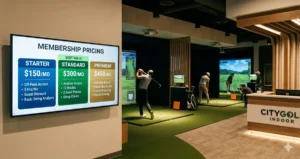
Memberships are the one stream on this list that succeeds or fails on execution. The revenue is only “recurring” if renewals and perks don’t require someone manually managing it. Platforms like AllBooked by Skedda make that easy: configurable membership tiers let you set discounted booking rates and perks, and a one-click signup link gets members booking the moment they join.
How to Fund It
Most indoor golf businesses are funded through some combination of owner equity, SBA loans, and equipment financing. The most common structure for a mid-size facility is 20–30% owner equity and the remainder through an SBA 7(a) loan, which allows up to 10-year terms on working capital and can finance both equipment and leasehold improvements.
Equipment financing deserves a serious look for simulator purchases. Leasing rather than buying commercial simulators can reduce upfront capital requirements by 40–50%, which matters a lot if you’re deploying capital across build-out, working capital, and equipment simultaneously. The monthly payment becomes a fixed operating cost rather than a capital burn, and many simulator manufacturers offer financing programs directly.
For a side-by-side look at the options, see 6 ways to finance a golf simulator business. Our Indoor Golf Startup Plan covers all six funding paths with real-world terms and what lenders look for in an indoor golf operator.
Your Next Steps
If you’ve read this far, you’re not browsing. You’re building. Here’s what to do with this information.
First, validate the market before committing to a space. Our startup guide shows how to validate your market: golfer density, existing competition, and corporate demand near your target location.
Second, use a real financial model, not a spreadsheet you built in an afternoon. The simulator manufacturer models you’ll be shown by sales reps consistently overstate utilization by 20–40%. Our data comes from actual facility surveys, not projections from companies trying to sell you equipment.
Third, get your lease terms right before you spend a dollar on build-out. Tenant improvement allowances, lease length, and renewal options are all negotiable and all have a direct impact on your cost structure. A bad lease is the fastest way to turn a viable concept into a struggling one.
Ready to Run the Real Numbers?
Our Indoor Golf Startup Plan includes the financial model, benchmarking data, and startup checklist refined over 2,000+ business plan downloads. Know exactly what your concept will cost and what it will earn before you sign a lease.
Get the Startup PlanLem got into indoor golf while evaluating whether to open his own facility, and has spent about 15 years researching indoor golf businesses. He has surveyed facility owners, indoor golf customers, and home simulator users to measure real-world utilization and ROI, and his work is behind the Yardstick Golf business plan, downloaded more than 2,000 times. He runs a golf simulator forum with 75,000+ followers and writes for the Sim Weekly newsletter.